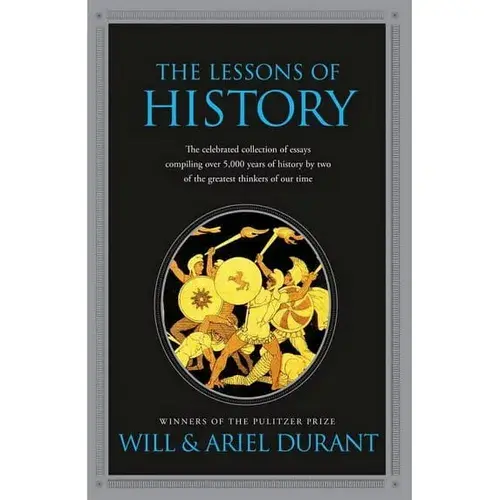
The Lessons of History
Will & Ariel Durant
Extremely interesting view of human nature, incentive in a globalized economy, incentives as an individual within a community. How history has shown us a lot of specific details and trends over time.
- Hesitations - An introduction acknowledging the limitations of drawing lessons from history
- partial knowledge and probabilities are all we really have and this is important to recognize
- man general behaves in similar ways over time
- the meaning of history
- history gives us scope to see how present events are big or small in context
- history gives us the ability to try and predict / see the patterns and trends and prevent catastrophy
- great places are usually melting pots of many backgrounds
- river cities
- control of rivers and trade routes when boats became important was super important (Greece and route to Asia)
- discovering new resources in the Americas and trade routes
- Now airplanes, makes it so new trade routes and land powers gain more power again
- man is tough, we preserve,
- Europe after the world wars, after 30 year war,
- man is curious and imaginative and continues on no matter what
- History and the Earth - Geography's influence on civilization
- geography limits us. We work around it with our tech but it still limits
- lack of fresh water access and rain creating deserts
- rainforests choking with jungle
- tornados and earthquakes
- river civilization because of agriculture -> boat tech and Mediterranean -> further boat tech and rize of Atlantic based trade and colonies -> planes and shifting of power back to land based places (China, US, Brazil)
- Biology and History - The role of human nature and biological factors
- life is competition
- peaceful with lots of resources
- violent without
- groups cooperate to compete with other groups
- greed and jealousy to protect / preserve self
- War is a nations competition
- competition creates progress
- life is selection
- some people are better equip better than others
- subject to our biology / genes, resources and culture background, psychology
- social inequality and other economics and tech breed further inequality
- freedom breed inequality and inequality happens naturally no matter what
- approximate equality, education opportunity and legal justice
- those with superior ability want more freedom and to flex, those below average want equality and the superior tend to win out in the long run
- society where more people can thrive gets better at group competition
- life must breed
- passion for quantity over quality, because fighting breeds quality
- low birth rate means eventual issues to others with more people's
- if too many mouths relative to food. Famine, pestilence and war rebalance the scales
- any evidence that we are getting dumber as a species because the smarter are having less children?
- lots of what we think of as smarts is by product of education, experience and opportunity. No great evidence that it's largely gene based
- no real way to test either how smart the limited poor really are
- life is competition
- Race and History - Examining racial theories and their validity
- history has great inventors, science, art, philosophy and architecture basically across all races and areas
- typically civilizations arise out of geographic opportunity not race or genes.
- we have many successful black people despite their disadvantages and lack of opportunity
- many races meld to create new culture and races
- racism has to do with ego, it's good motivation even if it's terrible. Also a unifying factor for a group to help them compete better
- Character and History - The consistency of human character across time
- instincts
- action or sleep
- fight or flight
- acquisition or avoidance
- association or privacy
- mating or rejection
- parental care or filiol dependence
- history has shown people don't really change. Motives and ends remain the same while the instruments may change
- people all want the same things regardless of class too
- social evolutions rather than biological
- balance or new ideas being spoken and also good that those ideas be questioned and tested
- competing for next meal and next mate
- if you can be smart you can just use it to justify what you want to do. Intellect is an individualist, rather than group oriented. Need to mature to do that. Need to subject ideas to history and reality.
- heros come from situations with immense demands
- instincts
- Morals and History - How moral codes evolve and function
- rules to try and get people to get to follow rules for order and growth
- soft rules. Incentives of the group and limits of technology
- freedom of women and contraceptives
- children being good as part of the group and farm hands
- morals to overcome aggressive instincts of mankind via social impulses
- religion supports social order which supports society, encourages group over individual instincts
- Religion and History - Religion's role in society
- hope instead of despair for the poor and class divided
- morality and law incentives
- Economics and History - Economic forces shaping civilizations
- money as a motivator, other tend to be infeasible eventually (slavery, policing for expensive and logistical reasons)
- men ranked on their ability to produce (except during war)
- collection of wealth by the few with skills and means together. Eventually peaceful redistribution or revolutionary redistribution (although revolutionary tends not to work as well)
- Socialism and History - The tension between equality and freedom
- capitalism - creative function for mechanisation and one guy amassing capital with promis of returns. Competition creates rise in excellence
- synthesis of capitalism and socialism
- Government and History of- Forms of government and their evolution
- democracy is good, because it provides equal access to opportunity for all generally, because it's good for the group on average. Things like education and opportunity access
- History and War - The persistence of conflict
- hard to get away from due to the fact that the side which invests in it tends to do better. Global competition and all that
- Growth and Decay - Why civilizations rise and fall
- reasons for development
- conquers and resources and laws
- presence of creative individuals, with initiative to respond to novel problems well.
- reasons for decay
- failure by leaders to meet the challenges of change
- reasons for development
- Is Progress Real? - A concluding reflection on whether humanity advances
- looking at history as progress not as evil lesson to be avoided
- family -> school instead of family for education and such, trains intellect but not character
- inequality is fundamental, people have variance and this will sort by ability and concentrate wealth and as a consequence The lessons of history notes.md Displaying The lessons of history notes.md.